Analysis
STI, RT60 and clarity, area by area.
Know whether the announcement will be understood, area by area. STI is estimated per IEC 60268-16 from the reverberation and the background noise. RT60 comes from the surfaces in octave bands, and a lively room gets a prescription for treatment.
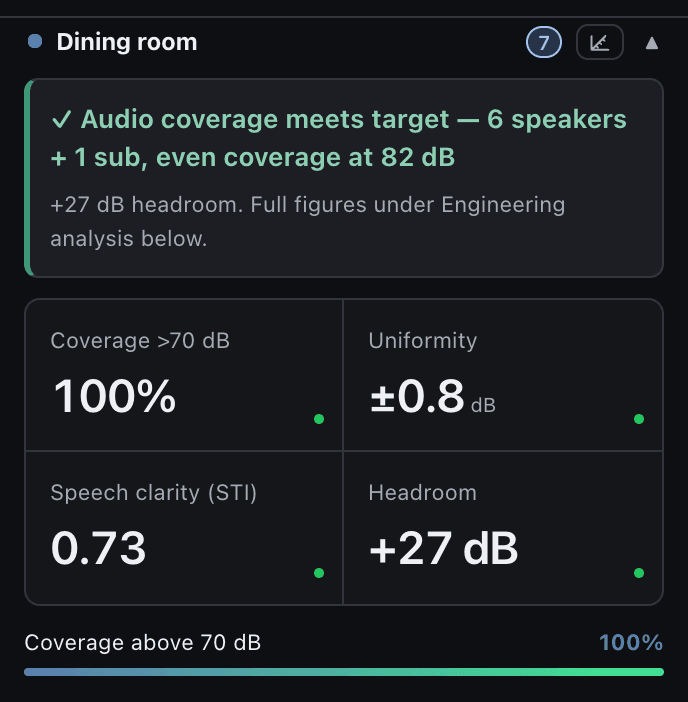
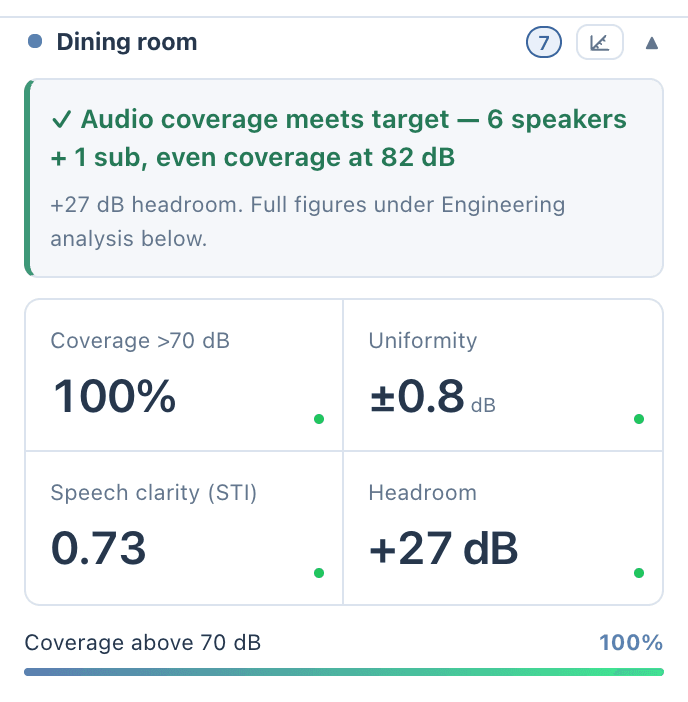
STI
Speech intelligibility, against a 0.60 target.
STI is estimated per IEC 60268-16 from the room’s reverberation and its background noise, so a noisy restaurant scores lower than a quiet boardroom at the same level. The calculation follows the 2011 edition: the full modulation transfer matrix over 14 modulation frequencies, noise masking per octave band, and the standard’s male weighting with redundancy correction.
One STI figure is used everywhere: the results card, the standards check and the PDF. With a noise floor set, the card adds signal to noise against the ambient: +15 dB for speech, +25 dB for music.
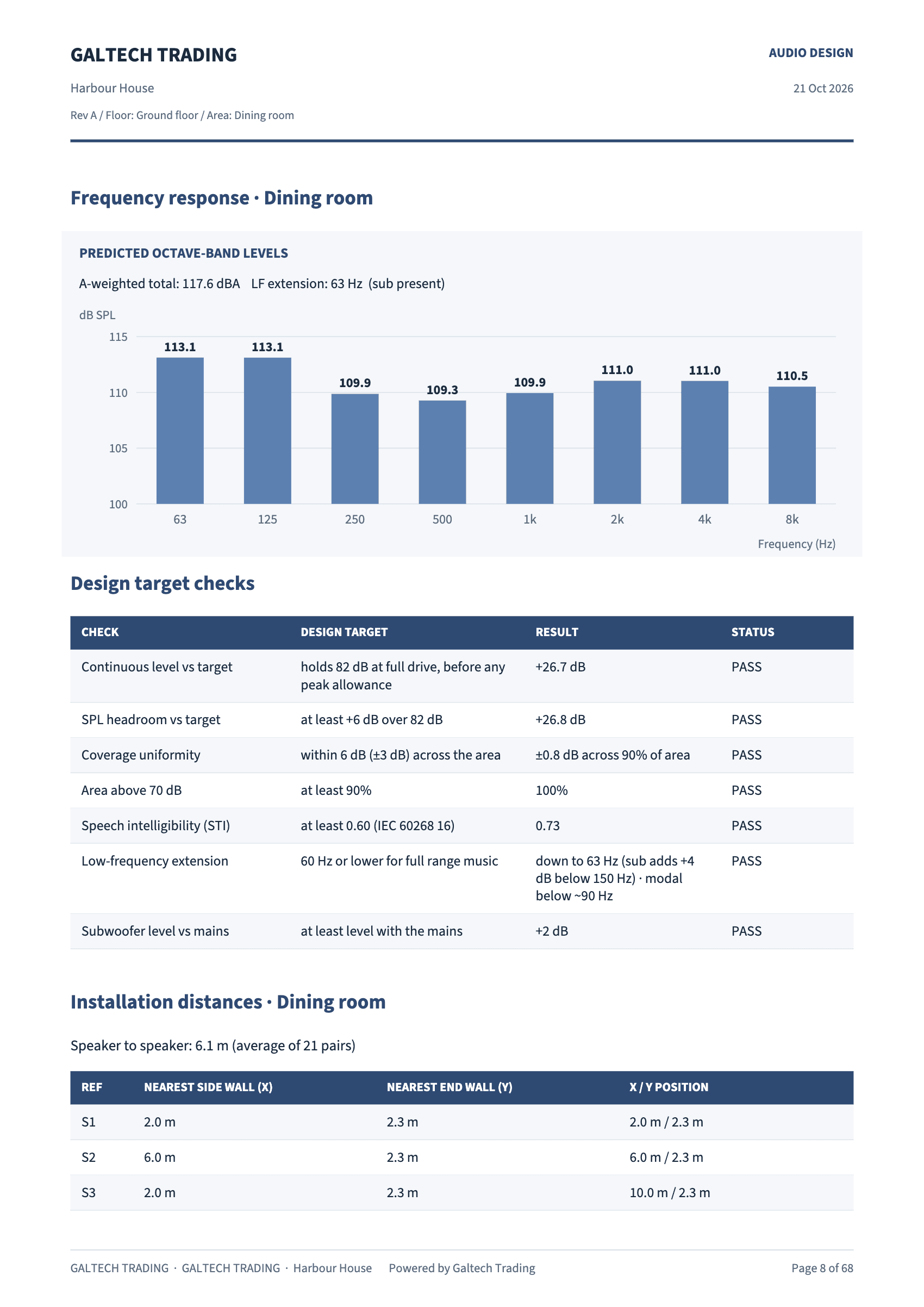
The standards check gives each area a pass, marginal or fail on level against target, headroom, uniformity, the area above target, STI, signal to noise and low-frequency support.
RT60
Reverberation, from the surfaces you choose.
Type an RT60 in seconds, or switch to From materials and pick the floor, ceiling and wall finishes from real material lists, each with its own absorption per octave band. Occupancy (empty, lightly occupied, seated or full) and a furnishing level from bare to soft-furnished adjust the result, because people and furniture absorb sound.
Reverberation is worked out by Sabine or Eyring in octave bands, with air absorption per ISO 9613-1 from the area’s temperature and humidity. Eyring holds where Sabine breaks down, in absorptive rooms.
Each area also lists its room modes, the low-frequency resonances set by its length, width and height, rated for how evenly they are spread, with the problem frequencies named. With a subwoofer in the area, Optimise sub placement ranks positions by how flat the bass is at the listeners.
C50, speech clarity
The ratio of early to late energy at 50 ms. Aim for 0 dB or higher.
C80, music clarity
The same at 80 ms. Roughly −2 to +4 dB is well balanced.
Noise floor
The venue’s background noise in dBA: about 70 for a busy restaurant, 45 for an office, 30 for a quiet home. It lowers STI in loud venues.
how it works
From an honest RT60 to a line on the quote.
Written from the tool’s commissioning and tuning cards.
Set an honest RT60
Type it, or choose From materials and the furnishing level. Add the venue’s noise floor, temperature and humidity in Edit area.
Calculate and read the card
Read STI, C50 and C80, signal to noise and the standards check. The treatment advisor shows before and after if the room is too lively.
Check a hard room
Press Run ray trace under Site calibration, and compare each pin’s ray-traced RT60, C50 and STI with the statistical figures.
Treat, then quote
Add the prescribed panel area, calculate again, and quote the panels as a line item. Commission speech systems with an STI or STIPA check on site.
Lesson 02 · 11:09Speakers, coverage and the 3D review
The whole lessontreatment
Too lively? The advisor prescribes the fix.
The Acoustic Treatment Advisor compares the area’s RT60 with the value recommended for its volume, on a DIN 18041-style curve. When the room is too reverberant it says how many square metres of absorption to add, as broadband panels (50 mm, NRC 0.85 or better, on the ceiling or upper walls).
It then predicts STI and C50 after treatment by running the acoustic engine again with the treated RT60, not by a rule of thumb. Carpet, drapes and the audience already count toward the total, so a busy venue may need less panelling than the empty room suggests.
Read the card as before and after, such as STI 0.72 to 0.90, and quote the panel area as a line item.
ray-traced check
A second opinion for hard rooms.
The statistical model is fast and accurate for normal rooms, but it assumes the reverberation is the same everywhere. The Ray-Traced Check (beta) fires 24,000 rays per speaker through the room’s real geometry (walls, open sides, open sky, doors and interior walls) and builds an echogram at each focus pin. From it come position-dependent RT60 (T20), C50 and STI, listed beside the statistical figures, with any real difference flagged.
Use it where one reverberation everywhere is doubtful: long or flat rooms, one treated surface in a hard room, glassy atria, spaces coupled through openings. In a normal room the two agree, and that agreement is the check. The trace floor map paints ray-traced RT60, C50 or STI across the plan.
It is an energy ray tracer, not a replacement for a measured commissioning. Results repeat exactly, are never saved into the project, and print in the audio report’s acoustics appendix.
in figures
The acoustics, in figures.
- STI target, IEC 60268-16
- 0.60
- rays per speaker in the Ray-Traced Check (beta)
- 24,000
- STI, dining room (demo)
- 0.73
- octave bands, 63 Hz to 8 kHz
- 8
| RT60 | Sabine or Eyring, in octave bandsAir absorption per ISO 9613-1 |
|---|---|
| STI | IEC 60268-16:2011 methodChecked against a 0.60 target |
| Clarity | C50 for speech, C80 for music |
| Signal to noise | +15 dB for speech, +25 dB for music, against the ambient |
| Frequency response | 8 octave bands, 63 Hz to 8 kHz, with an A-weighted total |
| Treatment | Square metres of absorption, to a DIN 18041-style curve |
| Ray-Traced Check (beta) | RT60 (T20), C50 and STI at each focus pin |
questions
Questions, answered plainly.
Is the STI figure a measurement?
No. It is a prediction from the model: a planning baseline, not a guarantee. Commission speech systems with an STI or STIPA check on site; site tracking records the measured STI next to the design.
When should I run the Ray-Traced Check?
Where the same reverberation everywhere is doubtful: long or flat rooms, very high ceilings, big openings, coupled spaces, one treated surface in a hard room. In a shoebox room the two models agree.
Which noise floor should I use?
The venue’s real background noise in dBA. The tool’s own guide figures are about 70 for a busy restaurant, 45 for an office and 30 for a quiet home. Left blank, the area is treated as quiet.
Ready when the client is.
Draw it, check it, show it, price it and hand it over, from one project.
15-day trial for approved companies. No card, nothing to cancel.