Audio
Set room acoustics and RT60
Give each area an honest RT60, typed from a measurement or estimated from its surfaces, occupancy and furnishing, plus its noise floor and its climate.
On this page
The acoustics belong to the area, not to the speakers. RT60, the reverberation time, drives the reverberant field, the clarity and the speech intelligibility score, so an honest value matters more than any other input. A drier room sounds clearer and needs less power to be understood.
Type it, or estimate it
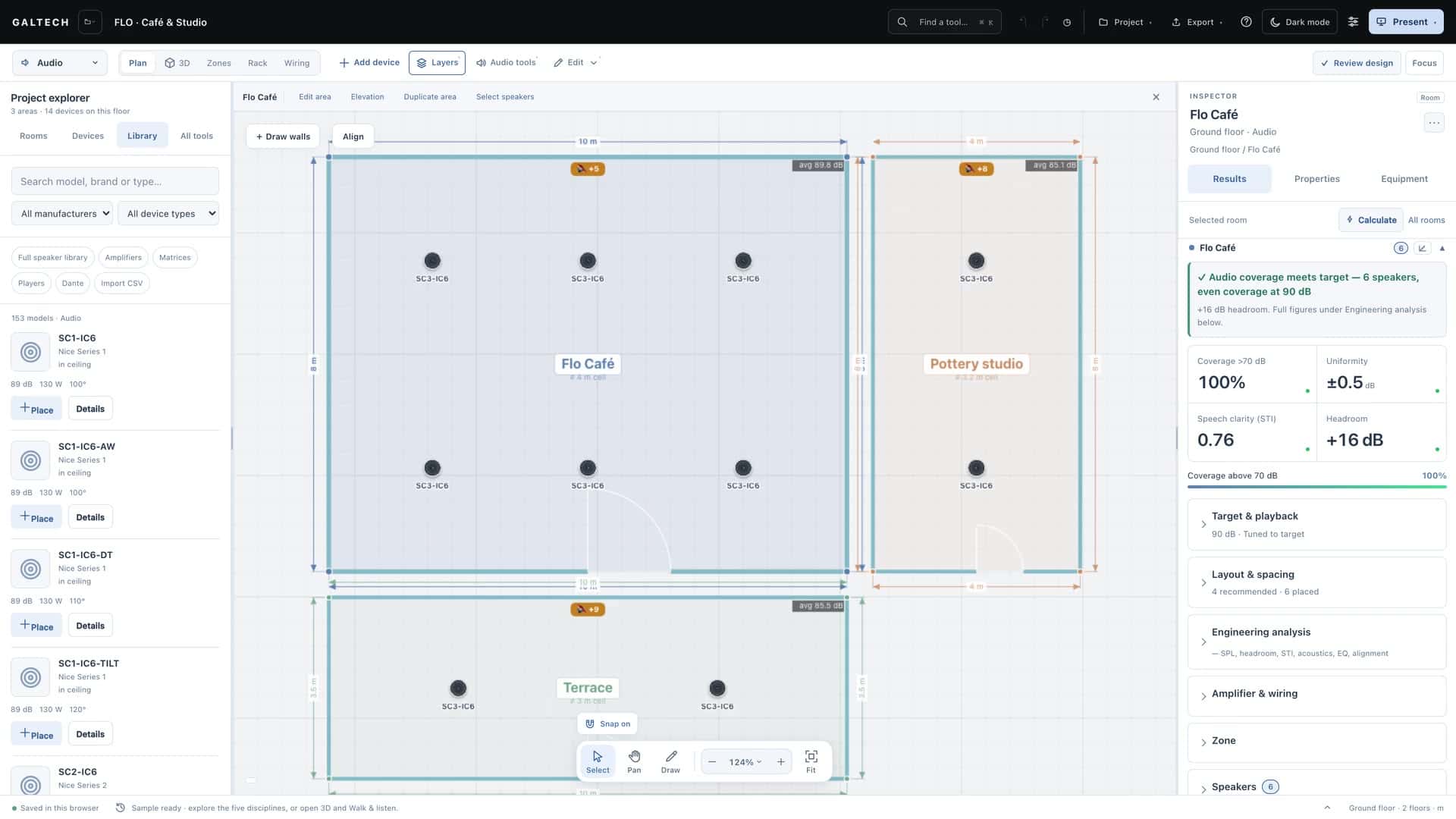
Select the area and choose Edit area.
- Typed. If you measured the RT60 on a site visit, type it in seconds.
- From materials. If you did not, switch to From materials and the tool estimates it from the room’s surfaces, octave band by octave band.
Estimate it from the room
- Surfaces. Pick the floor, ceiling and wall finishes from the material lists: concrete, carpet, glass, acoustic tile, curtains and more. Each carries its own absorption per octave band.
- Occupancy. Choose Empty, Lightly occupied, Seated or Full crowd. People absorb sound, so a full room is much drier than an empty one.
- Furnishing. The area’s furnishing chip cycles Bare, Light, Furnished and Soft-furnished. Furniture, rugs, drapes and sofas absorb sound and lower the RT60. Furnished is the baseline the venue presets use, so the design reflects the room as it will be lived in, not an empty shell.
The wall materials you drew count too. See Draw walls and set their materials.
The environment
The same dialog takes three more figures. Leave them blank for a quiet room at 20 °C and 50% humidity.
| Setting | What it changes |
|---|---|
| Noise floor, in dBA | The background level with nothing playing: about 70 in a busy restaurant, 45 in an office, 30 in a quiet home. The system has to rise above it, and a loud floor lowers the STI. |
| Temperature and humidity | The air absorption of the high frequencies over distance. Dry air swallows more treble, which matters in large or outdoor spaces. |
Terraces and courtyards
Roof takes the ceiling off for a terrace or a courtyard. With open sky, or walls removed, there is far less reflected sound and the reverberation changes completely. The outdoor venue presets start as open air.
What RT60 changes
- The reverberant level, and with it the direct-to-reverberant ratio.
- The clarity figures, C50 for speech and C80 for music, and the STI.
- The reverberation you hear in Walk and listen and in a shared 3D tour. Change the surfaces and the room sounds drier or livelier; share the area again afterwards to update the client’s link.
When the room is too live
The Acoustic Treatment Advisor, in the Audio tools menu and under the standards check, compares the room’s RT60 with the value recommended for its volume. When the room is too reverberant, it says how many square metres of absorption to add and predicts the STI and C50 after treatment. See Commissioning and tuning tools.
Room modes
Each area also lists its room modes: the low-frequency resonances set by its length, width and height. Clustered modes boom and big gaps sound thin; the tool rates the spread and names the problem frequencies. With a subwoofer in the area, Optimise sub placement finds the smoothest spot for it. See Commissioning and tuning tools.