On this page
“One speaker every three metres” is a rule of thumb that is right in some rooms and wrong in most. Spacing depends on three numbers you can read off the drawing and the datasheet, and on how even the level needs to be. Get those right and the count follows.
Three numbers set the circle
A ceiling speaker covers a circle on the listening plane. Its size depends on:
- the ceiling height, H;
- the listening height, h: about 1.2 m for seated listeners and 1.7 m for standing ones, the ear heights the tool gives its seated and standing people;
- the speaker’s coverage angle, θ, from the datasheet.
For a speaker with a 90° coverage angle, tan 45° is 1, so the circle is simply twice the drop from the ceiling to the ears. With seated ears at 1.2 m and standing ears at 1.7 m:
| Ceiling | Seated | Standing |
|---|---|---|
| 2.7 m | 3.0 m | 2.0 m |
| 3.0 m | 3.6 m | 2.6 m |
| 3.5 m | 4.6 m | 3.6 m |
| 4.0 m | 5.6 m | 4.6 m |
Two things stand out. Standing listeners need noticeably more speakers than seated ones under the same ceiling. And low ceilings are expensive: under 2.7 m, a standing crowd gets a circle only 2 m across from each speaker.
Which coverage angle
Datasheets quote coverage between the −6 dB points, usually at one frequency or averaged over a band. Patterns narrow as frequency rises, so a speaker quoted at 90° may cover less at the frequencies that carry consonants. Use the figure for the band that matters for the job, and be wary of a very wide angle quoted without a frequency.
Wider dispersion means fewer speakers, but it also sends more energy into the walls, which raises the reverberant field. Flat panels behave differently again. A distributed-mode panel such as the Flat Panel Audio DML500 is modelled in the tool with a 165° window and a loss of about 3 dB per doubling of distance, against 6 dB for a conventional speaker, so it is spaced from its own coverage rather than from a fixed grid.
Edge to edge, or overlapping
With the circle known, the grid is a choice about evenness. On a square grid there are three classic patterns:
| Pattern | Spacing | What you get |
|---|---|---|
| Edge to edge | S = D | Circles touch, leaving a gap at the centre of each four speakers. The fewest speakers |
| Minimum overlap | S ≈ 0.71 × D | The circles also cover that gap. More even |
| Centre to centre | S = D ÷ 2 | Each circle reaches its neighbours’ centres. The most even, and the most speakers |
A worked example shows the cost. A dining room 12 m by 7 m with a 3.0 m ceiling, seated guests and 90° speakers has a circle of 3.6 m:
| Pattern | Spacing | Grid | Speakers |
|---|---|---|---|
| Edge to edge | 3.6 m | 4 × 2 | 8 |
| Minimum overlap | 2.6 m | 5 × 3 | 15 |
| Centre to centre | 1.8 m | 7 × 4 | 28 |
Each step towards evenness roughly doubles the count. Background music tolerates more variation than speech does, which is where the looser patterns earn their keep.
How the tool sizes it
The Coverage Advisor sizes the grid for the model already placed in the area, from its real dispersion, the ceiling height and the target level, and shows the grid it recommends, for example 3 × 2, and whether you have placed enough. Each area also has a density setting:
- Even, the default, places speakers so their −6 dB circles just touch: a smooth pattern with fewer dips, which the tool treats as speech-grade.
- Economy stretches the spacing by about 40%, accepted practice for background music, for the fewest speakers that still cover the area.
Two practical limits apply. The grid is sized to a listening plane at least 1 m below the ceiling, and speakers are never packed closer than about 2 m apart. Loud venues stay dense either way, because the target level tightens the grid too.
Height changes everything
- Low ceilings with standing listeners demand many speakers. Look at wider-dispersion models before adding another row.
- High ceilings give bigger circles and fewer speakers, but each speaker throws further, so it needs more level to reach the target, and listeners hear relatively more of the room’s reverberation. Check the speech intelligibility as well as the count.
- Mixed rooms, such as a bar with standing guests beside seated tables, are best drawn as separate areas, each with its own listening height.
The coverage angle matters just as much. The tool’s Office template has an open plan of 12 m by 10 m under a 2.8 m ceiling with seated staff. With 90° speakers the circle is 3.2 m and an edge-to-edge grid needs 4 × 4, sixteen speakers. With 120° speakers the circle is about 5.5 m and the same pattern needs 3 × 2, six speakers, provided the wider pattern holds at the frequencies that matter.
The circle is not the level
Coverage geometry tells you where each speaker’s level stays within 6 dB of its level on axis. It does not tell you whether that level reaches the target. Sensitivity, power, the amplifier channel and the room’s reverberation decide that, which is why the tool sizes the count from the target as well, and why a gym or a sports bar ends up with a denser grid than a dining room of the same size.
Real ceilings also have lights, sprinklers, diffusers and beams. Keep the grid’s rhythm and shift a speaker rather than drop one; Optimize spacing and the Align tools in the tool even out what you move.
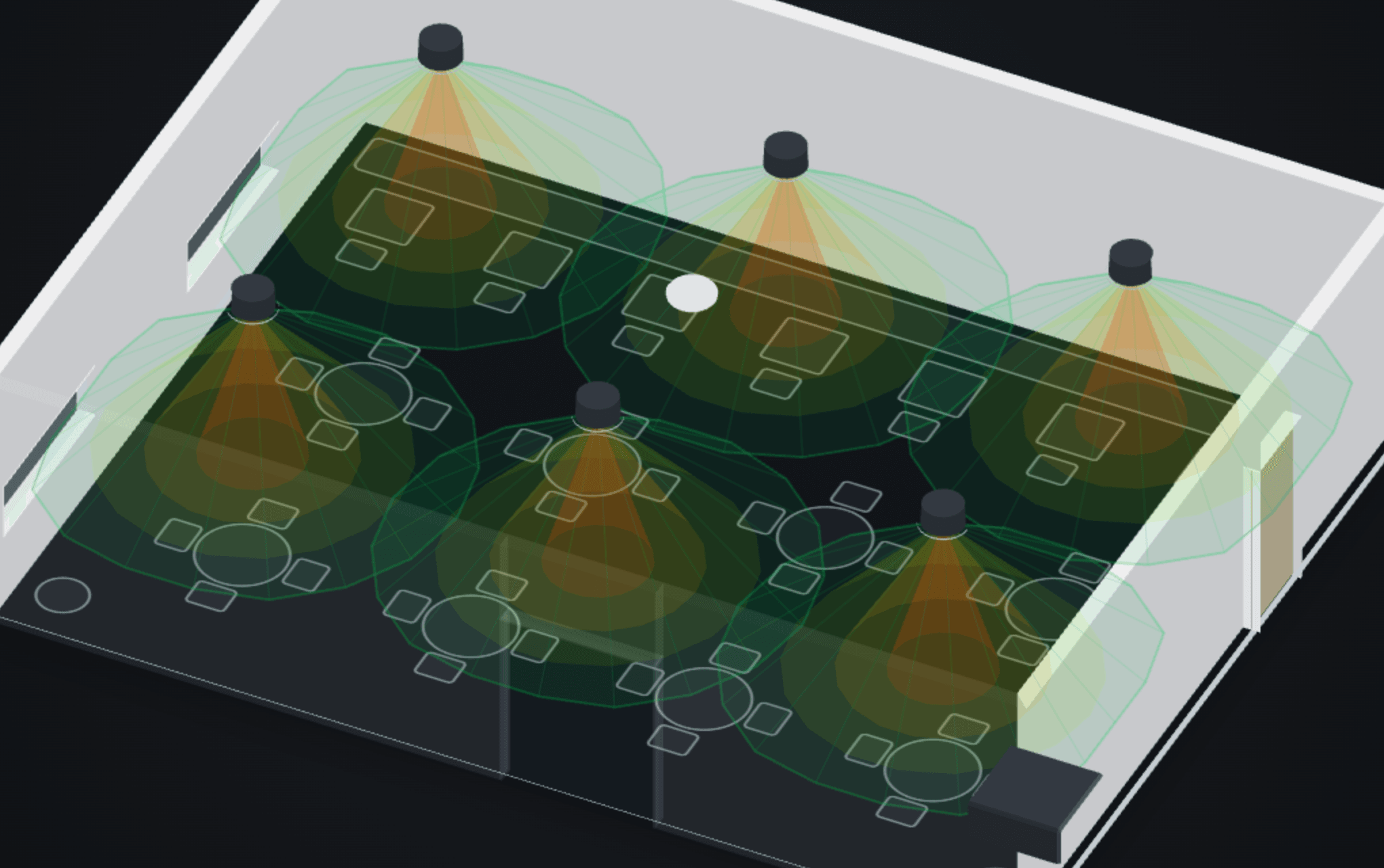
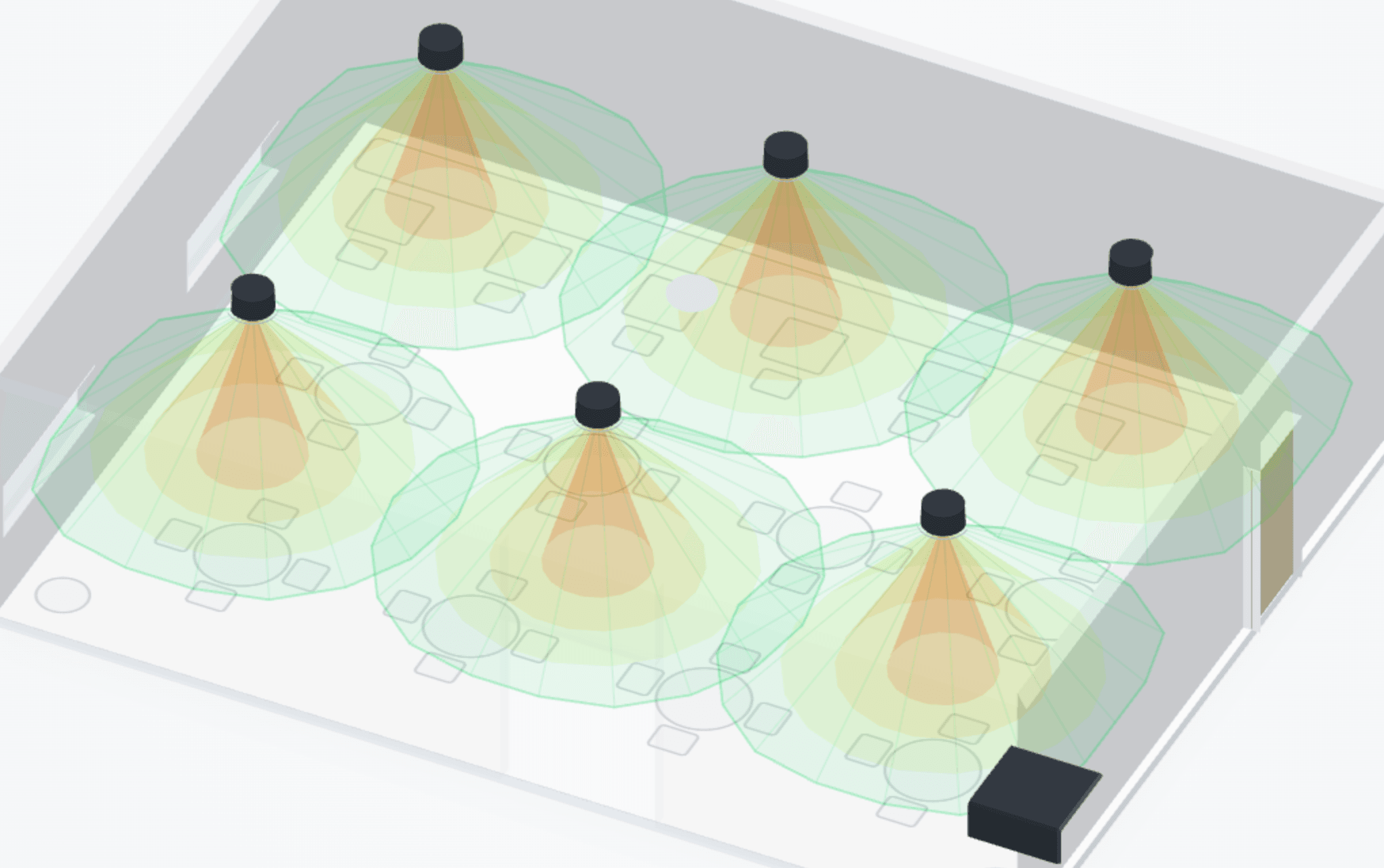
Check before you commit
Read the heatmap’s uniformity, where ±3 dB across 90% of the area passes the standards check. Look at the cones in 3D for gaps over the seating. Then walk the room with listeners at their real ear height, which is the quickest way to find the seat the grid forgot.