On this page
A terrace, a pool deck or a garden looks like the simplest area on the plan: no ceiling to cut, few walls, plenty of space. Acoustically it is the opposite of an indoor room, and designs that work indoors often disappoint outside. Here is what changes, and how to design for it.
No room to help you
Indoors, every surface sends some sound back. The reverberant field adds level everywhere and fills the gaps between speakers. Outdoors there is almost none of that: what reaches a listener is the direct sound from the nearest speakers, and it falls by about 6 dB for each doubling of distance. A guest 8 m from a speaker hears 12 dB less than one standing 2 m away.
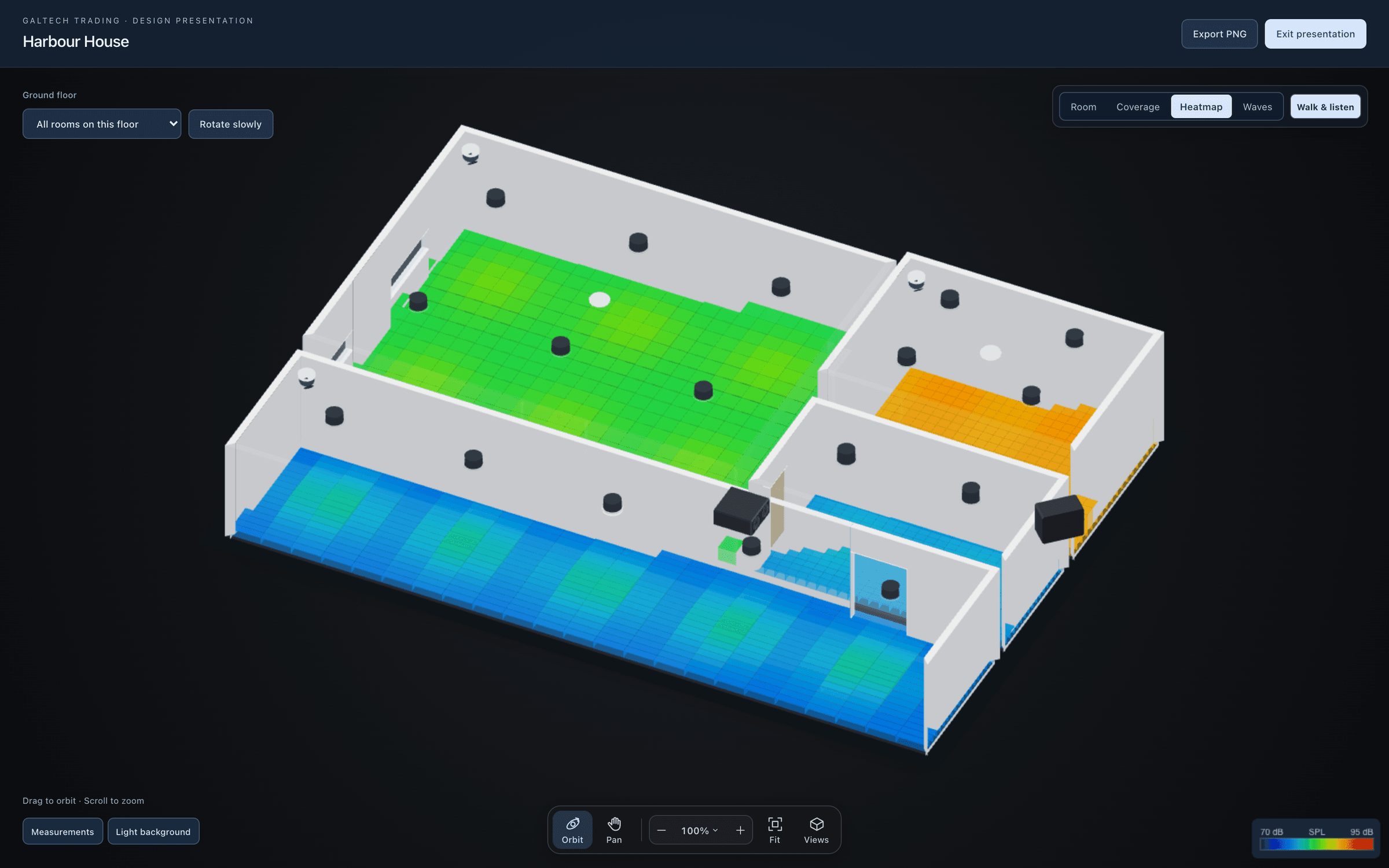
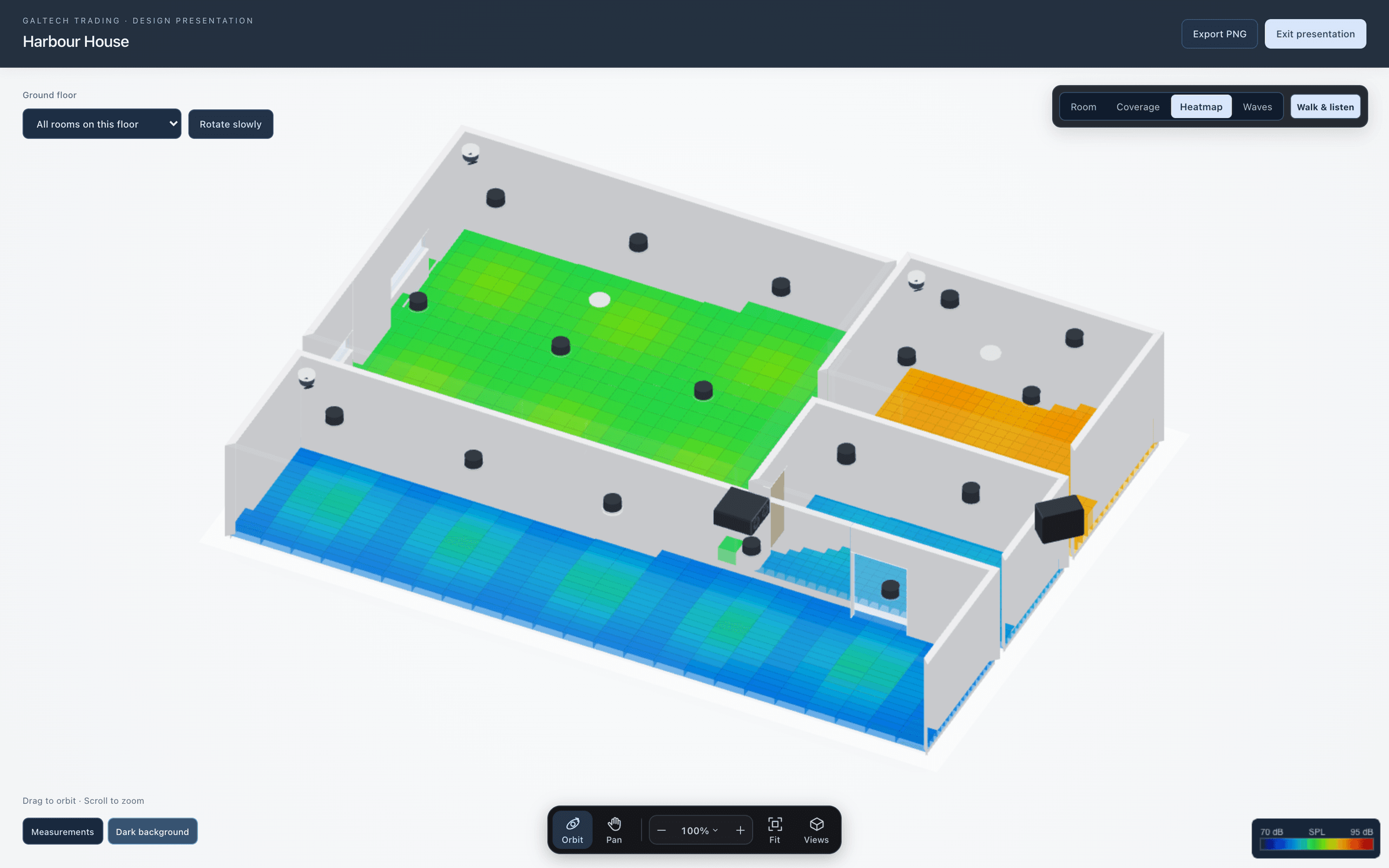
The tool models this when an area’s sides or sky are open. An open sky adds no reverberant field at all, and an open side shortens the estimated reverberation. Its two outdoor venue presets, Outdoor patio and Garden, start as open air with no RT60. Expect the heatmap to show the gaps that an indoor room would have filled.
Two other effects grow with distance outdoors:
- The air absorbs treble, more so when it is dry. The tool takes each area’s temperature and humidity into account.
- Late arrivals, from distant speakers or from a facade across the garden, can reach a listener long after the nearest speaker and behave like echoes.
Start from the noise
Outdoor spaces are rarely quiet. Traffic, fountains, pool pumps, air-conditioning condensers and neighbours all set a floor the system has to clear. Measure it, or estimate it honestly, for the time of day the space is busiest. The tool’s outdoor presets start from 60 dBA on a patio and 55 dBA in a garden, with a target level of 88 dB.
Then design the level from the noise, not from the speakers’ maximum. The tool checks the signal against the ambient you enter: at least 15 dB above it for speech and 25 dB for music. On a 60 dBA terrace, music that clears the noise comfortably sits around 85 dB.
With no reverberation to speak of, speech outdoors is limited by noise rather than by echo, so the same signal-to-noise margin is what keeps an announcement clear.
Many small speakers, close to people
The instinct outdoors is a few powerful speakers on the building, aimed at the garden. The result is loud by the house, quiet at the far end and clearly audible next door. A distributed layout works better:
- more speakers, each at a modest level, closer to the people listening;
- aimed into the area and down, away from boundaries and neighbours;
- satellites in the planting or on posts, with a subwoofer placed out of sight.
The tool’s Garden preset starts from Garvan Acoustic SN120 garden speakers at even density with a Nice SC-BT-10 subwoofer; its Outdoor patio preset uses the same satellites at economy density. Bass needs more help outdoors: there are no walls to reinforce it, so the subwoofer does more of the work than it would inside.
Built for the weather
Outdoor speakers live with sun, rain, irrigation spray, dust and, near the coast, salt air. Check:
- the ingress protection (IP) rating against the exact position, because under a canopy is not the same as in the path of a sprinkler;
- the materials: UV-stable enclosures and grilles, and corrosion-resistant fixings;
- the cable: rated for outdoor or direct-burial use, in conduit where it crosses hard landscaping, with sealed connections.
Long garden runs suit a 70 V or 100 V line, which keeps the cable light. Dual-voltage satellites such as the Nice SC-OG-4 and SC-OG-6 can run on a line or at 8 Ω.
Keep the neighbours on side
Local rules often limit outdoor noise, especially in the evening. Design to the level the space needs rather than the most it can take, put the outdoor area on a zone of its own so its level can be set separately, and let the distributed layout keep the sound where the guests are.
Check it before the client hears it
Walk the area in 3D and listen. In the walk-in and in the client’s shared tour, the Noise button switches the area’s background noise on and off, so you can hear whether the system clears it. The Ray-Traced Check (beta) treats open sides and open sky as openings, which helps on part-covered terraces, where the simple model is least certain.
As always, the prediction is a planning baseline, not a guarantee. Confirm the level and the noise on site, at the hours the space is actually used.