On this page
A subwoofer is the easiest speaker to add and the hardest to place. Put it wherever it fits and the bass can boom at one table and vanish at the next. This article covers why bass behaves differently from everything above it, where subwoofers go, how loud they should run, and how the tool judges them.
Bass does not spread like the rest
Wavelength is the speed of sound divided by the frequency. At 343 m/s, 100 Hz is about 3.4 m long and 50 Hz about 6.9 m: the same size as the room. Instead of spreading out evenly, low frequencies set up standing waves between parallel surfaces, called room modes. Where the reflections add up the bass booms; where they cancel it thins out. In a small room the difference from one seat to the next can be 10 dB or more.
The modes along each dimension sit where whole numbers of half wavelengths fit between the walls:
A room 6 m long has modes along its length at about 29, 57 and 86 Hz. Modes that bunch together boom; wide gaps between them sound thin. Higher up, the modes crowd so closely that the room behaves evenly again. The boundary, the Schroeder frequency, is roughly 2000 × √(RT60 ÷ V): about 91 Hz for a room of 240 m³ with an RT60 of 0.5 s. Below it, bass is a question of positions; above it, of the rest of the system.
Where subwoofers go
- Corners excite every mode: the most output and, often, the most boom.
- The middle of a wall sits on a null of the odd-numbered modes along that wall’s length, so it drives fewer of them.
- Two or more subwoofers, placed symmetrically at opposite wall midpoints or at the quarter points of a room, can cancel modes against each other. Several smaller subwoofers usually give more even bass across a room than one large one.
- The seats matter as much as the sub. A seat on the centre line of a room sits in a null of the odd-numbered modes across it, wherever the subwoofer is.
In the tool, Optimise sub placement does this search for you. With a subwoofer in an area, it runs a modal-summation calculation from 25 to 120 Hz for 11 candidate positions (the corners, the wall midpoints, the quarter points and the centre), listens across a 3 × 3 grid over the central listening area, and ranks the positions by how flat the bass is there. Move here puts the subwoofer on the best one. It rewards evenness, not the loudest spot.
Each area also lists its room modes, rates how evenly they are spread and names the problem frequencies, for example a boom at 50 Hz.
How loud the subwoofer should run
A subwoofer is there to extend the mains below where they roll off, somewhere under about 150 Hz. How far it should play above the mains depends on the venue:
- Background music: level with the mains.
- A bar or club with a target of 100 dB or more: at least 6 dB above them.
Those are the two settings of the tool’s “Subwoofer level vs mains” check. Its low-frequency extension row reports how low the area reaches and what the subwoofer adds below 150 Hz. For a target of 100 dB or more where the system does not reach down to 60 Hz, it suggests adding a subwoofer.
Why the heatmap leaves the subwoofer out
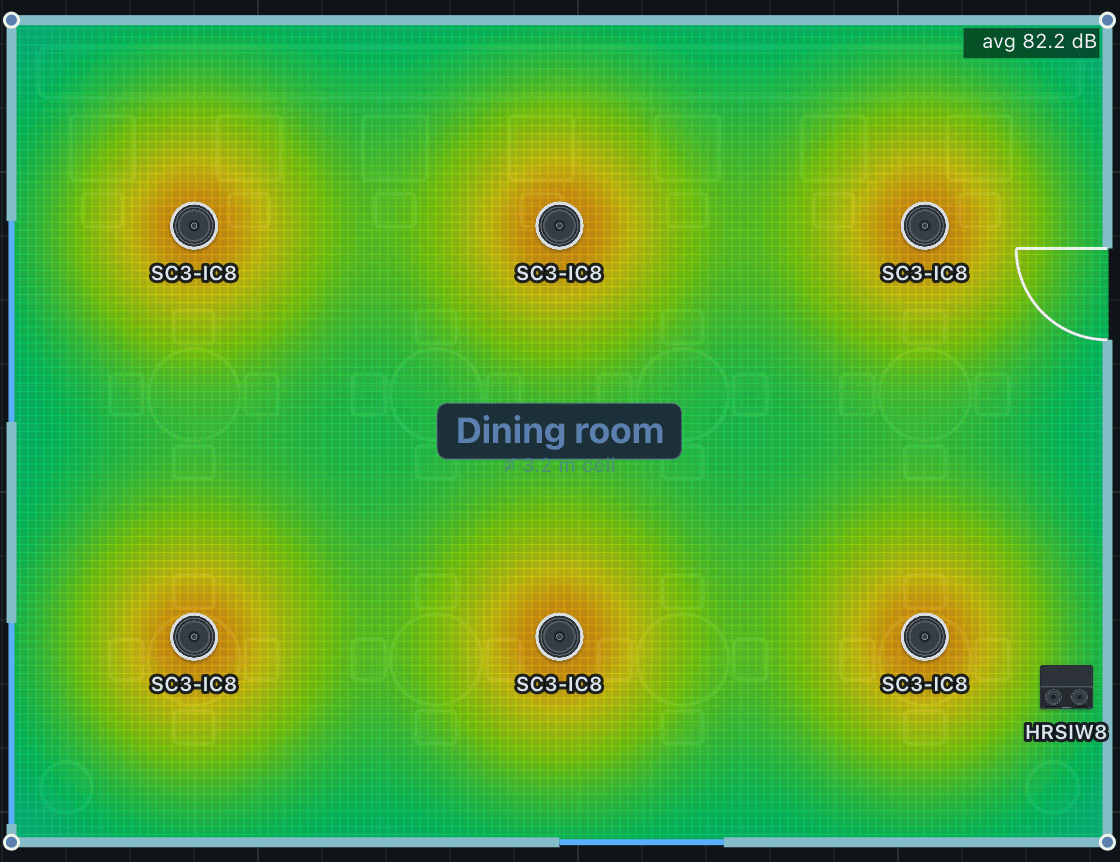
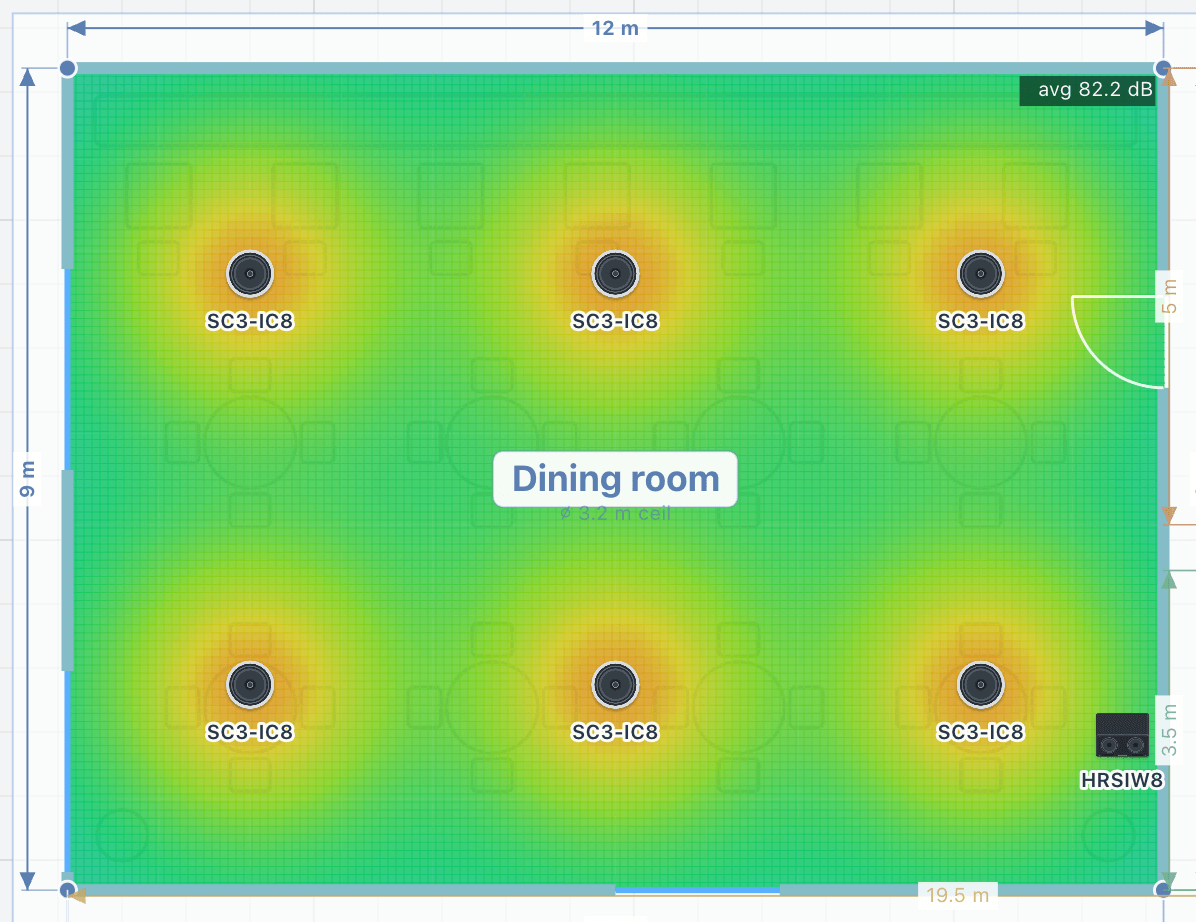
A subwoofer plays only the bottom of the range, so adding one should not make an area read louder across the board. Since version 1.10.22, “Subwoofers count where they play”, the tool keeps subwoofers out of the broadband figures: the heatmap, the average, the headroom, the coverage and the uniformity are the mains’ alone. The subwoofer shows up where it plays: in the 63 Hz and 125 Hz octave bands, in the low-frequency extension, in its level against the mains, and in the bass you hear in the 3D walk.
Subwoofers are also numbered on their own, so an area with two speakers and a subwoofer reads “2 speakers + 1 sub” rather than three speakers.
Amplifiers and cable
Subwoofers want power and a low-impedance channel of their own, even when the ceiling speakers ride a 70/100 V line. The tool keeps any subwoofer on its own low-impedance channel automatically and sizes its cable from the heavier range, 12 to 8 AWG. Mains and subwoofers are amplified separately, and the DSP preset sheet carries the crossover for any zone with a subwoofer, with a room-mode notch in its starting EQ.
Mind the neighbours
Bass travels through structure and passes walls far more easily than anything above it. Sound transmission class (STC) ratings start at 125 Hz, so they say little about the lowest notes. Where there are bedrooms or neighbours on the other side of a wall, keep subwoofers off shared walls, decouple them from the structure where you can, and set limiters.
Listen before you sign it off
The 3D walk models the room’s modes, so the bass swells and thins as you walk through the room, as it will on site. On site, measure at the listening positions rather than beside the subwoofer, and move the subwoofer before you reach for EQ: a notch can tame a boom, but no amount of boost fills a null.