On this page
Version 1.2.0, released on 5 July 2026, is the oldest release in the public changelog, and it starts with a correction. The model of the room's reverberant sound was wrong, and the numbers it fed were too kind. This release fixed it, then added the tools to check a room more than one way.
A corrected reverberant field
The reverberant, or diffuse, field was about 11 dB too low. That made speech intelligibility and the direct to reverberant figures too optimistic: a dense grid of speakers in a live room could read as near perfect STI.
The corrected model still lands your target SPL at the focus pins, or at the centre of the room when there are none. What changed is that it now shows which reverberant rooms need treatment or delay. Polygon and L-shaped rooms also use their true floor area and perimeter.
The release note said it plainly: expect STI and coverage numbers to move, and check a couple of rooms you know. That is still the right habit after any change to a model.
A second opinion: the Ray-Traced Check
The statistical model treats a room as one well-mixed space. The Ray-Traced Check, in beta, does not. It fires 24,000 rays per speaker through the room's real geometry, its walls, open sides, open sky, doors and interior walls, with the absorption of your materials in each octave. It returns RT60, C50 and STI at each focus pin, beside the statistical figures.
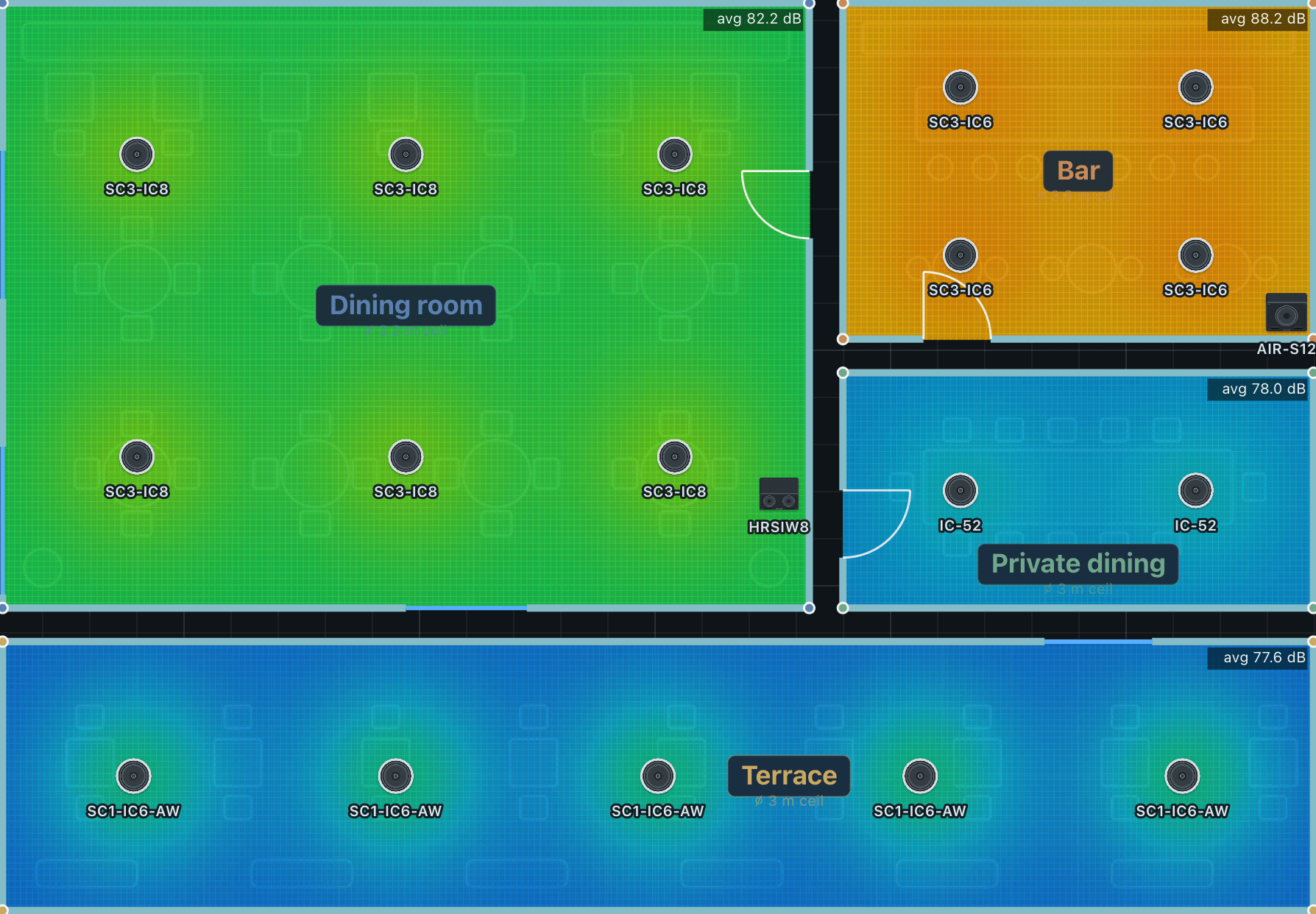
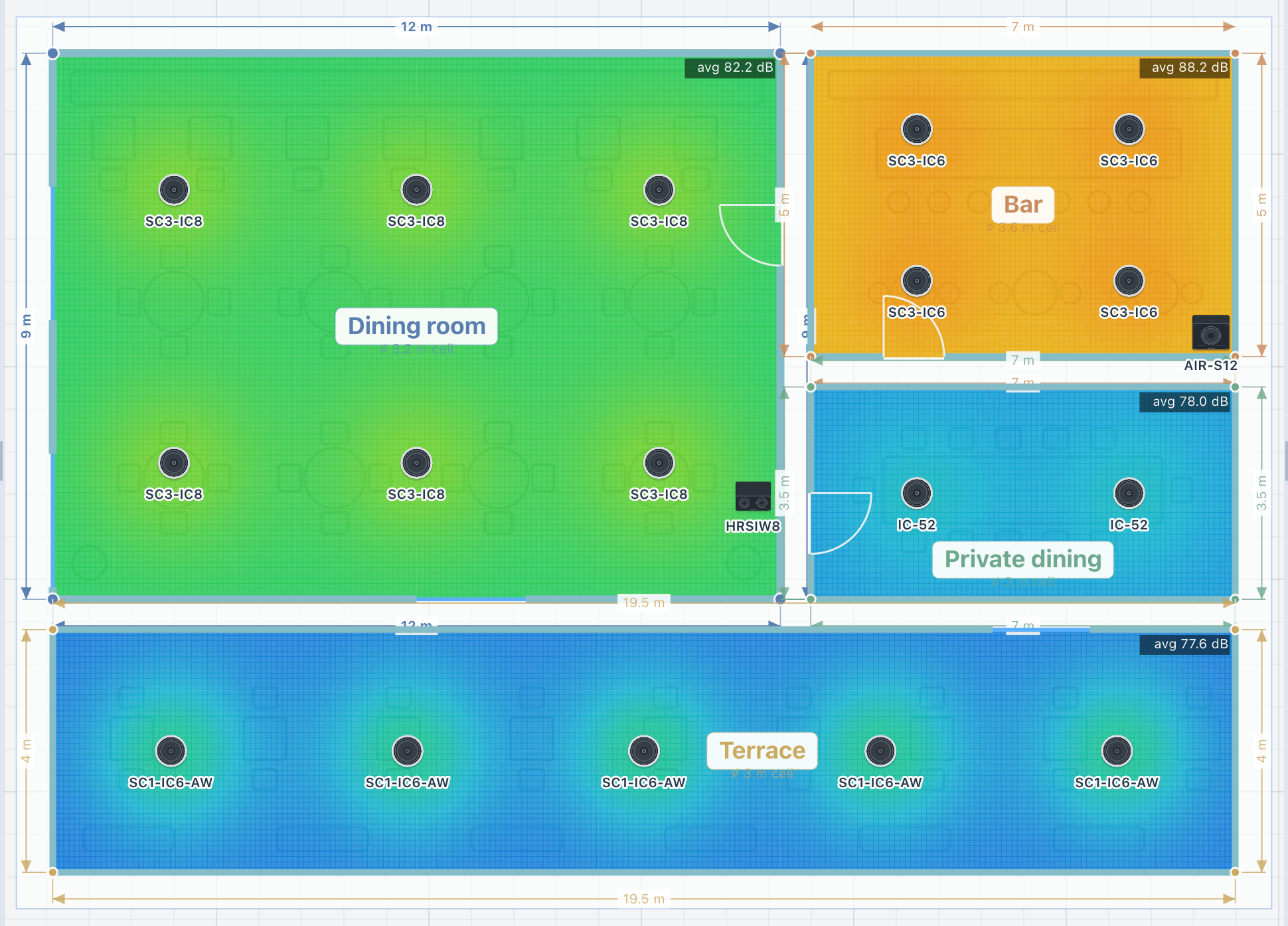
In an ordinary room the two agree, and that agreement is your confidence check. In a long hall, a glassy atrium or a venue open on one side they differ, and the trace shows which seats need another speaker or some treatment. A ray-traced floor map paints RT60, C50 or STI across the whole floor, and pin results include RT60 per octave band from 125 Hz to 4 kHz.
Focus pins: where the sound matters
Instead of assuming the middle of the room, you drop a pin where the sound should concentrate: the bar, a stage, a group of seats. An area can have as many as it needs. The pins then drive the commissioning. Tuned levels land the target at each pin, time alignment syncs the arrivals there, site calibration expects the meter reading taken standing at them, and the pins appear in the 3D walk and in the tour you share with the client.
Faster layout, fewer guesses
- The heatmap updates live while you drag a speaker.
- Apply layout in the Coverage Advisor places the recommended grid in one click, and Optimize spacing evens it out.
- The treatment advisor says how many square metres of absorption a reverberant room needs, sized to its volume, and the predicted speech clarity after treatment.
- The High accuracy layer adds the first reflection off the walls, floor and ceiling to the map, which matters most near the boundaries.
A commissioning sheet for the DSP
The DSP preset export became a branded PDF that the commissioning engineer can work from: for every output, the level and polarity, the high and low-pass filters with their slopes, the crossover, a parametric EQ as a starting voicing, the limiter and the time-alignment delay.
Every one of these figures is a prediction, and a prediction is a planning baseline, not a guarantee. Commission with an SPL meter and an STI check on site.
Release notes
v1.2.0 Corrected acoustics, ray tracing, focus pins and pro DSP export
- 8 new items
- 1 fix
- Fixed
The reverberant field was about 11 dB low, which made STI and direct-to-reverberant figures too optimistic. The corrected model shows which rooms need treatment or delay.
- New
Ray-traced floor map: RT60, clarity (C50) or STI painted across the whole floor.
- New
Ray-Traced Check (beta): 24,000 rays per speaker through the room’s real geometry, with per-octave absorption, giving RT60, C50 and STI at each focus pin beside the statistical model.
- New
Focus pins: mark where the sound matters, such as the bar or a stage. Tuning, time alignment and site calibration all reference them.
- New
Treatment advisor: how many square metres of absorption a reverberant room needs, and the predicted speech clarity after treatment.
- New
The heatmap updates live while you drag a speaker.
- New
Apply layout places the recommended grid in one click, and Optimize spacing evens it out.
- New
The High accuracy layer adds the first reflection off the walls, floor and ceiling to the map.
- New
The DSP preset export is a branded PDF commissioning sheet: level, polarity, filters, crossover, parametric EQ, limiter and delay for every output.